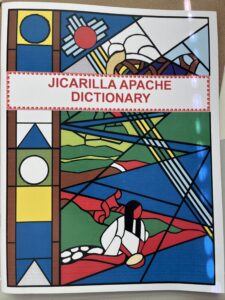
Jicarilla Apache Dictionary (1981), Native American Materials Development Center and Ramah Navajo School Board, Inc.
About this dictionary:
This dictionary was created through a partnership between the Jicarilla Language and Culture Program and the Native American Materials Development Center, with support from a Title VII grant. It was compiled by Carson Vicenti, a Jicarilla tribal member, with help from many Jicarilla speakers, educators, and community members.
The dictionary was designed as a classroom resource for elementary students and others learning about the Jicarilla Apache language. It is not intended to be a complete dictionary of the language, but rather a collection of commonly used words and phrases. Entries are arranged alphabetically from Jicarilla to English to help learners become familiar with the Jicarilla alphabet and vocabulary. The book also includes a pronunciation guide, background information for teachers, and 120 illustrations.
Physical copies are available at the JADE Administration office.
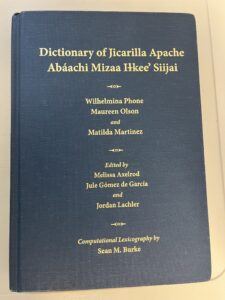
Dictionary of Jicarilla Apache: Abáachi Mizaa Iłkee’ Siijai (2007). Wilhelmina Phone, Maureen Olson, and Matilda Martinez; edited by Melissa Axelrod, Jule Gomez de Garcia, and Jordan Lachler. University of New Mexico Press.
About this dictionary:
This dictionary was created for the Jicarilla Apache Nation and is one of the most complete resources available on the Jicarilla Apache language. The authors spent many years collecting words, language examples, pronunciations, and cultural knowledge to help preserve and teach the language.
The project included support from community members, researchers, and language specialists. Sean M. Burke developed the database and software used to organize and publish the dictionary. Funding was provided by the National Science Foundation, and the project was completed with the support of the Jicarilla Apache Culture Center and Tribal Council.
Physical copies are available for purchase online.
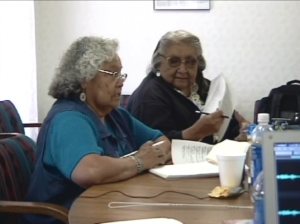
Above: Wilma Phone and Matilda Martinez (October 2002).
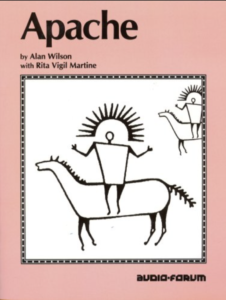
These books were developed through the current J.A.D.E Jicarilla Language Program, Jicarilla Cultural Affairs, and earlier language programs that operated from the 1980’s through the 2000’s. Physical copies for some of these books can be obtained at the J.A.D.E Administration Office.
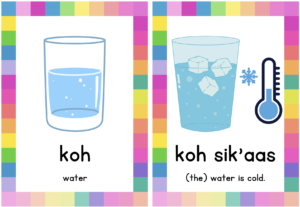
The posters and flashcards in this section are designed to support classroom instruction and language learning. We recognize that many Abáachi Mizaa teachers who come to work in our schools often have to create their own teaching materials from scratch. By providing these resources, we hope to help lighten that burden and make it easier to teach and learn Abáachi Mizaa. For teaching materials, it is important to teach language in context instead of standalone words. Future projects will update these materials.
Physical copies are available for pickup at the JADE Administration.
Games are a fun way to learn a language. Board games and card games can be adapted to teach and learn Jicarilla. All you need to do is play the games in Abáachi! Here in this section, we have created a list of games that we have played or used in the classroom for teaching Abáachi Mizaa. Each activity includes instructions, key vocabulary, and phrases needed to facilitate the game in Jicarilla. Future work will look to expand upon this section and add audio for the games.
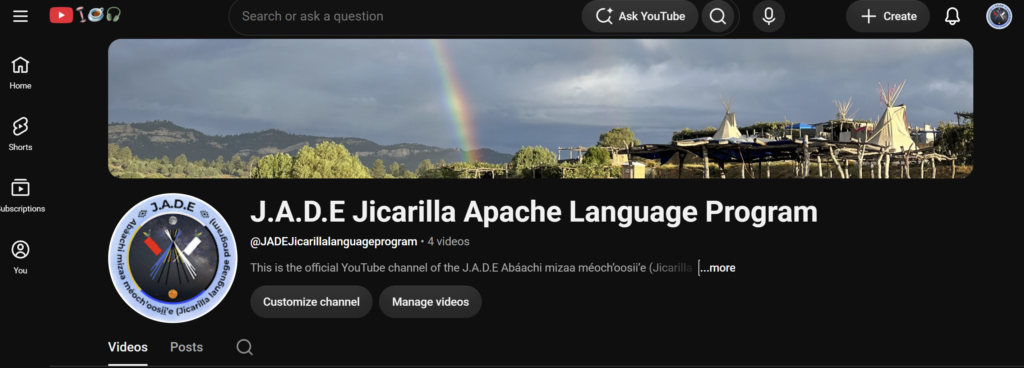
This section includes a link to the official J.A.D.E Jicarilla Apache Language Program YouTube channel. There, you can access audio and visual materials for selected books, along with other helpful language lessons.
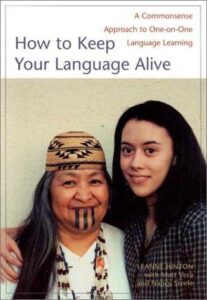
In this section, you will find resources that can be used for immersion and language acquisition activities. These resources include books that provide practical guidance on using immersion-based approaches, as well as wordless books that can be used for listening and comprehension activities.
Wordless books are a great way to practice Jicarilla through storytelling. A fluent speaker can narrate the story in Jicarilla while learners listen, follow along with the pictures, and build their understanding of the language.
*This section is currently under construction! Check back for updates!*