Language Resources

The language resources in this section are provided to support the preservation and continued use of the Jicarilla language within our community. We ask that all visitors treat this knowledge with respect. Please do not use, reproduce, or profit from these materials for personal or commercial gain, especially if you do not have a connection to the Jicarilla people or the community from which this knowledge originates. Iheedn. 

Dictionaries and Grammars

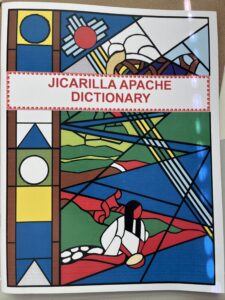
Jicarilla Apache Dictionary. 1981, Native American Materials Development Center, Ramah Navajo School Board Inc. 

Acknowledgements: This is a dictionary of the Jicarilla Apache language. It has been compiled and prepared in association with the Jicarilla language and Culture Program (Dulce, N.M.) and the Native American Materials Development Center (Albuquerque, N.M.). This project was made possible through a Title VIl grant for the development of Jicarilla Apache classroom materials. The material contained within was compiled by Carson Vicenti, a member of the Jicarilla Apache tribe. Mr. Vicenti received a B.A. in Linguistics at Oregon State, and has development materials for the Dulce Title VII project. Special thanks go to Leall Vicenti, Darren Pesata and Richard Tecube for Their help as linguistic informants; Wilma Phone, Lydia Pesata and Patricia Torivio for their help as informants and as the main source for verification; Geraldine, Jo Ann, Hendrina, Verda, and Diane of Title VII for their early Help prior to this project; the backing of the Language and Culture Committee; the NAMDC Center; and mostly to Susan, Camille, and Jasper, for their Continual support throughout this project.

Introduction: The use of this dictionary is intended as a supplement for general instruction in the Jicarilla languages at the Elementary school level and programs aimed at providing general exposure to the Jicarilla language. It is in no way intended as a comprehensive compilation of the language. This dictionary has provided in it information for both student and teacher. The Introduction and Pronunciation Guide are particularly intended for the teacher as an aid for planning lessons on the alphabet and its sounds, and as information concerning the history and status of the language. The dictionary entries are listed in alphabetical order from Jicarilla to English (e.g., a’ai-magpie to zhaał- money). This has been done so as to get the reader acquainted with the Jicarilla alphabet as well as provide a ready reference for translation from Jicarilla to English. The words and phrases contained within make up a basic corpus of words found in everyday speech. Also included are 120 pen and ink illustrations for the child’s enjoyment.

Physical copies are available at the JADE Administration office. 
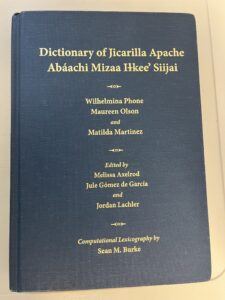
Dictionary of Jicarilla Apache Abáachi Mizaa Iłkee’ Siijai. Wilhelmina Phone, Maureen Olson, and Matilda Martinez. Edited by Melissa Axelrod, Jule Gomez de Garcia, and Jordan Lachler. Computational Lexicography by Sean M. Burke. University of New Mexico Press. 2007.

Preface: The Dictionary of Jicarilla Apache: Abáachi Mizaa Iłkee’ Siijai is intended to be the first edition of this dictionary written by and for the Jicarilla Apache Nation in Dulce, New Mexico. The authors, Dr. Wilhelmina Phone, Mrs. Maureen Olson, and Mrs. Matilda Martinez, spent innumerable hours working to provide a huge body of words and language samples for this dictionary. They have spent yet more hours reading through several drafts of the dictionary, standardizing the spelling of thousands of words, providing current pronunciations and translations for older forms, and directing the construction of this dictionary of their language. We, the editors, are responsible for omissions and errors, and apologize for them. We thank the authors for the thousands of hours of sharing, conversation, laughter, patience, and loving dedication they gave to this project. We thank them for their wisdom, generosity, and skill.
Dr. Wilhelmina Phone has been working on the documentation of Jicarilla for more than thirty years. She has written her own memoirs, collected oral histories from other Jicarilla speakers, written lesson plans for Jicarilla language classes for adults and children, and written cultural stories and descriptions of cultural activities, all of which she has shared with other members of the Jicarilla Apache Nation. Dr. Phone has created an extremely significant body of language documentation, including video and audio records of language and traditional culture, a grammar of the language, a dictionary, and a large collection of excellent pedagogical materials. She both teaches the language herself and serves as trainer and mentor for other teachers. She was awarded an honorary doctorate for her achievements by the University of New Mexico in May 2006. Mrs. Maureen Olson has a master’s degree in education, and has taught in the public school system for eighteen years. She has been teaching Jicarilla Apache in the public school for the past seven years. In addition to teaching the language to children, she also has a year of experience teaching Apache to adults and has offered several three-day workshops for adults as well. She served as coordinator for the school’s bilingual program at the elementary, middle, and high school levels. Last year, she chaired the Jicarilla Language Team, and led the work in negotiating, writing, and procuring a Memorandum of Agreement (MOA) for Certifying Native Language Teachers. Currently, she is chairing the Jicarilla Language Revitalization Committee, serving as Jicarilla Language Revitalization Coordinator, and working as the Tribe’s Jicarilla Language Teacher.
Mrs. Matilda Martinez has been working on the dictionary of Jicarilla Apache for the past four years, and is a specialist in Jicarilla traditional cultural practice. She has contributed enormously to both the content and the shape of the dictionary. Her knowledge has been invaluable in the comparison of older forms with newer forms  and in the analysis of the Hoijer texts as she remembers how “they used to say it” in earlier years.
We also want to acknowledge the contributions of Adelaide Paiz, Charlotte Vigil, Emelene Baltazar, and Myra Sandoval to the content of the dictionary. These women lent their expertise on several occasions to provide new words and definitions.
Jonathan Wells graciously told us stories and shared many hours of conversation about his parents and grandparents, contributing richly to the content of the dictionary. We give particular thanks to our Computational Lexicographer and programming genius, Sean Burke, without whom this edition would not be possible. Mr. Burke created the database and the programming that allowed the database to be printed in a variety of formats. This brilliant work has been extended to databases for a dozen other languages, including Nambé Tewa, Haida, Tlingit, Keres, and Cree. Sean was a source of inspiration and support throughout the Jicarilla dictionary project, as well as being miraculously hard-working, patient, and ingenious. Thanks, Sean! Research assistants on the project were Taimi Ames-Clark, Erin Debenport, Candace Maher, and Mariann Skahan. Many thanks to them and to all our other visitors to the work sessions in Dulce.
We also thank our families for their support and interest through the years of fieldwork and their patience during the production of the dictionary, with special gratitude to Roberto García for his assistance with database editing. Humor shortens the hours and lightens the load.
The NSF provided funding for this project (National Science Foundation, BCS-0094373, Dictionary of Jicarilla Apache: Abaachi Mizaa Ikee’ Siijai funding period from December 15, 2000, to November 30, 2003, with an extension to November 30, 2004) and we thank them for their support and generosity.
We also thank the American Philosophical Society for their gracious permission to use words and example sentences from the Jicarilla Apache texts gathered by Harry Hoijer in the 1930s and 1940s. The dictionary was produced under the auspices of the Jicarilla Apache Culture Center and according to an August 2000 Tribal Resolution from the Jicarilla Apache Nation Tribal Council. We are indebted to the Culture Center and the Tribal Council for allowing the project to proceed and for their assistance.

Physical copies are available for purchase online. This work is currently one of the most comprehensive resources on the Jicarilla language.
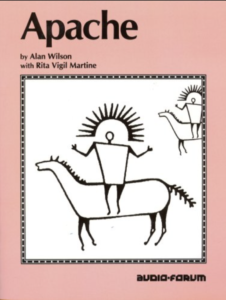
Books

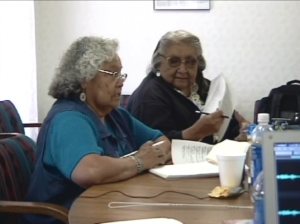
These books were developed through the JADE Language Program, Jicarilla Cultural Affairs, and earlier language programs that operated from the 2000s through the 2010s.

Physical copies of the books can be obtained at the JADE Administration Office. 

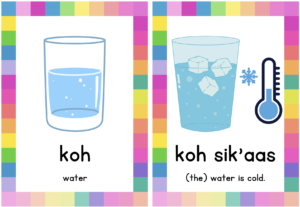
Posters

The posters and flashcards in this section are designed to support classroom instruction and language learning. We recognize that many Jicarilla language teachers who come to work in our schools often have to create their own teaching materials from scratch. By providing these resources, we hope to help lighten that burden and make it easier to teach and learn the Jicarilla language.

Physical copies are available for pickup at the JADE Administration.
Games

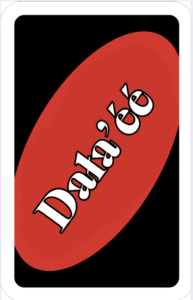
This section contains a collection of games designed to support learning the Jicarilla language. Each activity includes step-by-step instructions, key vocabulary and phrases needed to facilitate the game in Jicarilla, as well as a QR code linking to audio recordings for pronunciation.

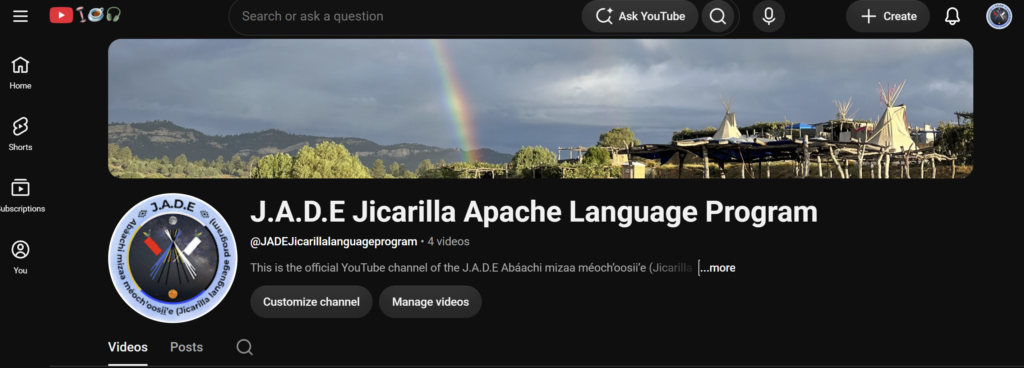
Videos

This section includes a link to the official JADE Language Program YouTube channel. There, you can access audio and visual materials for selected books, along with other helpful language lessons.
Links and Other Resources

Lorem ipsum dolor sit amet, consectetur adipiscing elit. Ut elit tellus, luctus nec ullamcorper mattis, pulvinar dapibus leo.